
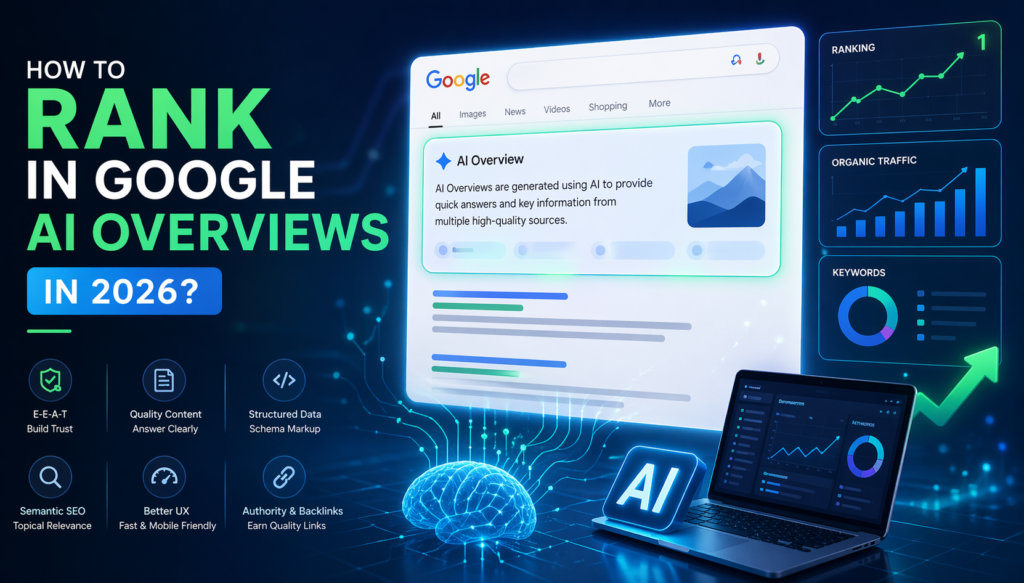
Search has moved beyond just being about those all-familiar blue links. As the era of AI-enabled snippets such as the Google AI Overview dawns, your web content cannot just rank, but it needs to be selected as a reliable source for this snippet by AI. Not having your site featured in such an overview means losing out on a massive opportunity in 2026.
Here are the steps you can take to optimize your content for AI Overviews.
What Are Google AI Overviews?
AI Overviews are smart summaries produced right on the search results page by Google via AI technology. Google no longer provides links to relevant sites but rather offers answers by extracting information from many trustworthy sources.
This means:
- Users get answers faster
- Fewer clicks go to traditional listings
- Only the most reliable and well-structured content gets featured
1. Focus on E-E-A-T (Experience, Expertise, Authority, Trust)
Google strongly emphasizes information that shows practical experience and authority.
To improve your E-E-A-T:
- Show author expertise (bio, credentials)
- Add real examples, case studies, or results
- Use original insights instead of generic content
- Get mentions or backlinks from trusted sites
AI Overviews favour content written by people, experts, and sources that can be trusted.
2. Answer Questions Clearly and Directly
AI Overviews are meant to produce answers to questions. Your content should:
- Start sections with clear answers
- Use question-based headings (H2, H3)
- Provide concise explanations (40–60 words ideal)
Example:
What is AI SEO?
AI SEO refers to the optimization of content for comprehension and selection by AI-powered search engines.
That boosts the probability of appearing on Google’s AI Overviews.
3. Use Structured Content (Make It Easy for AI)
AI doesn’t “read” like humans—it scans for structure.
Optimize your formatting:
- Use bullet points and numbered lists
- Add tables where relevant
- Use proper heading hierarchy (H1 → H2 → H3)
- Keep paragraphs short (2–4 lines)
Structured content = easier extraction = higher chances of AI inclusion.
4. Optimize for Semantic SEO (Not Just Keywords)
Traditional keyword stuffing is outdated. AI focuses on context and meaning.
Instead of repeating:
“best car service center in Bangalore”
Use variations:
- top auto repair workshop
- reliable car garage near you
- vehicle maintenance services
Also include related concepts, entities, and synonyms to build topical depth.
5. Add FAQ Sections (Very Important)
FAQs are gold for AI Overviews.
Include 4–6 relevant questions like:
- How does Google AI Overviews work?
- How to optimize content for AI search?
- Is SEO still important in 2026?
Keep answers short, clear, and fact-based.
6. Improve Content Freshness
AI systems prefer updated and relevant information.
Do this:
- Update blogs regularly (every 3–6 months)
- Add new statistics or trends
- Refresh outdated sections
Fresh content signals reliability to AI.
7. Build Topical Authority
Don’t just write one blog—build a content ecosystem.
Example:
If your niche is SEO, create:
- AI SEO strategy
- Technical SEO in 2026
- Voice search optimization
- Local SEO trends
Interlink them properly. This helps Google see your site as an authority.
8. Use Schema Markup (Structured Data)
Schema helps search engines understand your content better.
Important schema types:
- FAQ schema
- Article schema
- How-to schema
This increases your eligibility for AI summaries and rich results.
9. Optimize for User Intent
Every search has an intent:
- Informational
- Navigational
- Transactional
Match your content exactly to what the user wants.
10. Improve Page Experience
AI doesn’t just read content—it considers user experience.
Focus on:
- Fast loading speed
- Mobile responsiveness
- Clean design
- Easy readability
Better UX = higher trust = better AI selection chances.
11. Get High-Quality Backlinks
AI Overviews rely on trusted sources.
Build backlinks from:
- Industry blogs
- News websites
- Business directories
- Guest posting
Quality matters more than quantity.
12. Write Like a Human, Not a Robot
AI prefers content that feels natural and helpful.
Avoid:
- Keyword stuffing
- Over-optimization
- Robotic tone
Instead:
- Write conversationally
- Use simple language
- Provide real value
Future of SEO: AI-First Optimization
The future of SEO in 2026 has evolved beyond ranking. It is now more about getting selected by AI technologies such as Google Search Generative Experience.
To win:
- Be the best answer
- Be trustworthy
- Be structured
Conclusion
Optimizing for ranking in Google AI overviews demands a change from traditional SEO to AI optimization. By applying E-E-A-T, structure, semantic SEO, and user intent, your content can become one of those generated by the AI.
If your content is valuable enough, Google’s AI will automatically select it.