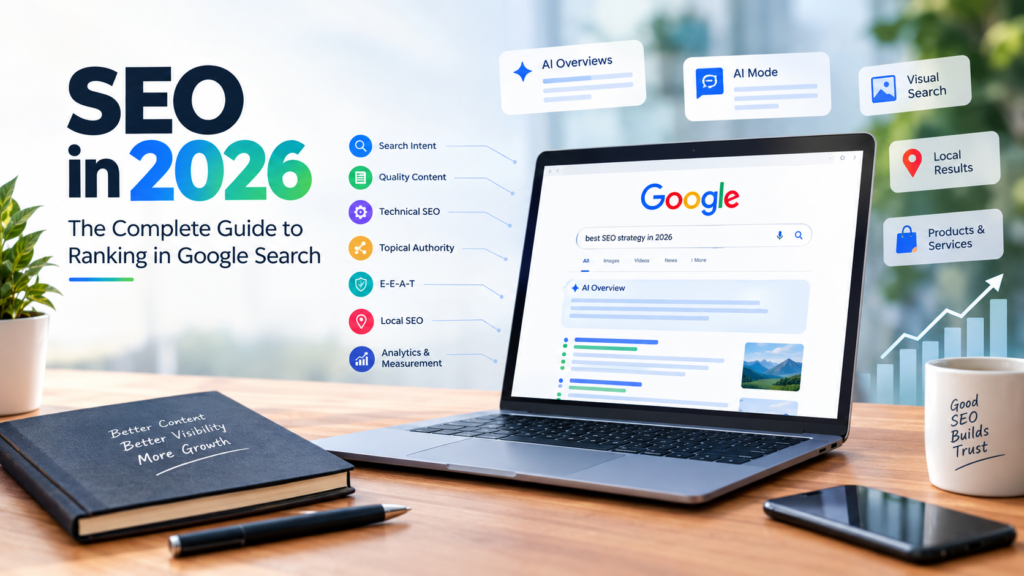
SEO is not just about using keywords and creating backlinks anymore. Google Search in 2026 has taken new shapes, which include AI Overviews, AI Mode, new search experience, changes in user behavior, and increased importance of valuable and credible content.
The mission of companies, websites, and SEO experts is still the same: to allow the right users to find the right content at the right time. The difference is that the methods of doing this have changed.
This guide will reveal SEO practices that work in 2026 and describe how to develop a sustainable SEO strategy for Google.
What Is SEO in 2026?
SEO in 2026 is the process of improving a website so that search engines can understand its content and users can easily find and benefit from it.
Modern SEO combines several areas, including:
- Keyword and search-intent research
- High-quality content creation
- On-page SEO
- Technical SEO
- Internal linking
- Topical authority
- Local SEO
- Structured data
- Digital PR and relevant link building
- User experience
- Performance measurement
Google does not publish a complete checklist of ranking factors. Therefore, SEO should not be treated as a formula where completing a fixed number of tasks guarantees a position.
Instead, focus on creating a website that is technically accessible, useful, relevant, trustworthy, and genuinely better than competing results.
How Google Search Has Changed in 2026
Key SEO Strategies for 2026
Google Search has evolved to offer information via much more than simple blue links. AI Overviews and AI Mode are redefining information discovery, but other Google search features can offer direct answers, visuals, local information, product offerings, and other specialized searches.
Google has stated that even its AI search technologies are dependent upon fundamental SEO practices. The company’s 2026 guidance addresses optimizing for generative AI search technologies, but it stresses the importance of traditional SEO best practices.
That means companies should not neglect their traditional SEO practices and opt for an entirely different approach called “AI SEO.”
Rather, optimize the fundamentals and make your content clear to both humans and search engines.
1. Focus on Search Intent
Understanding why someone searches is more important than simply targeting a keyword.
For example, someone searching for “SEO services in Dubai” may be looking for an agency, while someone searching for “how does SEO work” is probably looking for educational information.
Before creating a page, determine whether the search intent is:
- Informational
- Commercial
- Transactional
- Navigational
- Local
Then create content that directly satisfies that intent.
2. Create Original, Helpful Content
Publishing hundreds of AI-generated articles is not a sustainable SEO strategy.
Google’s spam policies specifically warn against scaled content abuse, including producing large amounts of unoriginal content primarily to manipulate search rankings. This applies regardless of whether the content was created using AI or another method.
AI can help with research, ideation, outlining, and workflow efficiency. However, the final content should provide genuine value through expertise, original insights, examples, experience, data, or useful analysis.
3. Build Topical Authority
Instead of publishing unrelated articles simply because keywords have search volume, build comprehensive coverage around your main subject.
For an SEO website, for example, you could create content around:
- SEO strategy
- Technical SEO
- Local SEO
- Content SEO
- Keyword research
- Google Search Console
- E-E-A-T
- AI and SEO
- Link building
- SEO analytics
Connect these pages through strategic internal links.
This helps users navigate your website and gives search engines clearer context about the topics your website covers.
4. Strengthen On-Page SEO
On-page SEO still matters in 2026.
Optimize important elements such as:
- SEO title
- H1 and heading structure
- Meta description
- URL
- Introduction
- Image alt text
- Internal links
- Relevant keywords and related concepts
However, avoid forcing the same keyword repeatedly into every paragraph.
Natural language and clear communication are more important than keyword density.
5. Invest in Technical SEO
A great article cannot perform well if search engines cannot properly access or understand the website.
Technical SEO should include:
- Crawlability
- Indexability
- XML sitemap
- Robots.txt configuration
- Canonical URLs
- Mobile usability
- Page experience
- Core Web Vitals
- HTTPS
- Clean website architecture
- Structured data where appropriate
Structured data can help Google understand specific types of content and may make eligible pages suitable for richer search appearances.
6. Optimize for AI Overviews and AI Search
The AI Overviews have been incorporated into Google Search and Google itself now gives guidelines on how websites can show up in these AI Overview searches. AI Overviews are also included in Search Console performance statistics.
There is no dependable shortcut that will ensure you to be included in AI Overview.
What you need to do is produce content which answers questions, has expertise, relies on accurate information and offers unique value.
It is here that the strategic frameworks like Answer Engine Optimization (AEO) and Generative Engine Optimization (GEO) can come handy.
Forget about ranking for a particular keyword. Produce content which can be understood and relied upon when asking questions.
Why E-E-A-T Matters
E-E-A-T stands for:
- Experience
- Expertise
- Authoritativeness
- Trustworthiness
These principles are especially important for websites dealing with areas where inaccurate information can cause significant harm.
Show real expertise through author information, professional experience, original examples, credible references, transparent business information, reviews, case studies, and accurate content.
Trust should be visible throughout the website—not added as an afterthought.
Local SEO in 2026
For businesses serving specific locations, local SEO remains essential.
A strong local SEO strategy can include:
- Optimizing your Google Business Profile
- Maintaining consistent business information
- Creating useful location-specific pages
- Collecting genuine customer reviews
- Building relevant local citations
- Publishing locally relevant content
- Using appropriate LocalBusiness structured data
- Earning relevant local links and mentions
Avoid creating dozens of nearly identical location pages with little unique value. Local pages should actually help people in the specific area.
How to Measure SEO Performance
Ranking position alone is not enough to measure SEO success.
Monitor metrics such as:
- Organic clicks
- Organic impressions
- Click-through rate
- Keyword visibility
- Conversions
- Leads
- Revenue
- Indexed pages
- Engagement
- Landing-page performance
Google Search Console is particularly useful for understanding how your website performs in Search, including impressions, clicks, and other search visibility data.
The objective is not simply to get more traffic. The objective is to attract relevant traffic that contributes to business goals.
SEO Mistakes to Avoid in 2026
Some common mistakes can hold websites back:
- Keyword stuffing
- Publishing low-value AI content at scale
- Copying competitor content
- Ignoring technical SEO
- Building irrelevant backlinks
- Creating pages solely for search engines
- Neglecting internal linking
- Ignoring local search
- Focusing only on rankings instead of conversions
- Following outdated SEO tactics without checking current Google guidance
Google’s spam policies explicitly cover attempts to manipulate both traditional search results and generative AI responses.
The Future of SEO
SEO has moved beyond the manipulation of ranking factors to a new concept of having an effective digital footprint.
The websites that are going to succeed in 2026 will have valuable content, accessible technology, expertise, branding, organization, authority, and user experience.
Artificial intelligence will continue to influence search behavior, but that won’t make SEO obsolete; that means quality SEO is becoming more important.
The websites that are going to succeed will provide the user with truly valuable information, expertise, products, services, experiences, or a new perspective that can’t be easily replaced.
Conclusion
An effective SEO in 2026 cannot rely on keyword optimization only.
Organizations need to concentrate on search intent, valuable content, topic authority, technical SEO, internal links, local SEO, E-E-A-T, structured data, and results for businesses. In addition, companies should understand how the new concept of AI Overviews or other generative search experiences affect visibility on the Web.
No tricks exist to ensure the top ranking on Google.
The long-term SEO strategy lies in providing valuable experiences to users by making the website accessible and understandable for both search engines and people.
In 2026, a successful SEO strategy does not depend on following each algorithm update. Create a website that deserves to be ranked on search results pages.