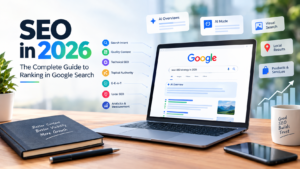

Search has changed more in the last two years than in the previous decade. People no longer just type a query and scroll through ten blue links — they ask ChatGPT Search, Perplexity AI, Gemini, or Google’s AI Mode a question and expect a direct answer. That answer often comes with a citation, and if your website isn’t the one being cited, your traffic quietly disappears to a competitor.
This is why learning how to get your website cited by AI search engines has become one of the most important skills in modern SEO. It’s no longer enough to rank on page one. You need to become the source that AI models trust enough to reference by name. In this guide, I’ll walk you through exactly how that works and what you can do about it, based on what’s actually moving the needle in 2026.
What Does It Mean to Be Cited by AI Search Engines?
Ranking and being cited are two different games. Ranking means your page shows up in a results list that a person has to click through. Citation means an AI system reads your content, decides it’s trustworthy and specific enough, and quotes or references it directly inside a generated answer.
Google AI Overviews, Google AI Mode, ChatGPT Search, and Perplexity all work this way. They pull from multiple sources, synthesize an answer, and link back to the pages that supplied the most useful, well-structured information. Your job isn’t to win a click anymore — it’s to win a mention.
That shift matters because AI citation SEO rewards clarity and authority over volume. A short, precise page with real expertise can outperform a bloated 3,000-word article stuffed with keywords. The models are looking for signal, not noise.
7 Proven Ways to Increase AI Citations
Getting cited consistently isn’t luck. It comes down to a handful of habits that separate sites AI trusts from sites it ignores.
- Create original, experience-based content: Share real results, case studies, or firsthand observations. AI models are increasingly trained to favor content that demonstrates lived experience over generic advice recycled from other blogs.
- Build topical authority: Cover a subject in depth across multiple connected pages rather than writing one isolated article. Semantic SEO rewards sites that clearly own a topic cluster, not just a single keyword.
- Strengthen Entity SEO: Make sure your brand, author, and business are clearly defined entities — consistent naming, a solid Google Business Profile if relevant, and mentions across the web that reinforce who you are and what you do.
- Improve E-E-A-T signals: Experience, expertise, authoritativeness, and trust remain the backbone of both Google Search and AI Overviews. Detailed author bios, credentials, and transparent sourcing all help.
- Use structured data (schema): Article, FAQ, and Author schema make it far easier for crawlers and AI models to understand what your page is about and who wrote it. This is one of the simplest technical wins available.
- Write answer-first content with semantic headings. Lead with the direct answer, then explain the reasoning. Headings phrased as natural questions help AI systems extract and quote your content accurately.
- Keep content fresh and updated: Outdated statistics or old screenshots quietly disqualify a page from being cited. A simple quarterly review of your top pages goes a long way.
Common Mistakes to Avoid
Even excellent websites fail to capture citations due to preventable mistakes. Be aware of these mistakes:
Firstly, outdated content is among the worst mistakes since AI models recognize outdated dates and prioritize recent content even if its advice is relevant. Second, low E-E-A-T is a common mistake that happens when there is no author or their credentials to prove authority.
Both keyword stuffing and duplicate content will make crawlers and AI think that your page is not natural and does not provide value to readers. Finally, missing information about an author and poor “About” section will destroy some hidden trust signals that AI models use in the decision-making process.
A quick comparison between the two will show what differences exist between them. Firstly, traditional SEO considers rankings, click-through rate, and backlinks. AI search optimization considers clarity of the text, factual structure, and expertise which cannot be challenged.
The two overlap but there is more room left for precision in case of AI-first content.
Final Thoughts
Getting your website mentioned or cited by AI-based search engines is not a hack or a quick fix; it is actually a consequence of creating a legitimate site which is credible, organized, and created by expert writers. Work on the topics that establish authority, high E-E-A-T signals, structured data, and answer-first approach, and citations will be an outcome.
Currently, those websites that are ranking on top of AI Overviews, AI Mode, ChatGPT Search, and Perplexity are not trying to figure out how to get ranked by algorithms; instead, they are providing answers to questions effectively. The long-term play should be based on prioritizing quality over any hacks possible.
FAQs
What does it mean for a website to be “cited” by an AI search engine?
It means an AI system like Google AI Overviews, ChatGPT Search, or Perplexity has read your page, judged it trustworthy and specific, and referenced or linked to it directly inside a generated answer — rather than just listing it as one of several ranked results.
Is AI search optimization different from traditional SEO?
Yes. Traditional SEO focuses on rankings, click-through rate, and backlinks, while AI search optimization focuses on clarity, structured facts, and expertise a model can confidently repeat. They share a foundation, but AI-first content needs more precision and less filler.
Does schema markup actually help with AI citations?
Yes. Article, FAQ, and Author schema make it easier for AI crawlers to understand what a page covers and who wrote it, which increases the odds of that page being pulled into a generated answer.
How often should I update content to stay eligible for AI citations?
A quarterly review of your top-performing pages is a good baseline — checking for outdated stats, broken links, and stale examples keeps content eligible for both Google Search and AI Overviews.
Does E-E-A-T matter for AI Overviews and ChatGPT Search the same way it does for Google Search?
Yes. Experience, expertise, authoritativeness, and trust signals — like visible author credentials and transparent sourcing — are weighed heavily by AI models when deciding which sources are safe to cite.