
The digital marketing space has never been changing as fast as it is now. Simply focusing on search engine optimization techniques has become completely insufficient. If the brands want to be competitive in 2026, they need to understand GEO and AEO terminology.
Consumers have started getting used to advanced search techniques that incolve asking questions rather than using key words and conducting searches through voice queries while receiving quick responses from AI bots. This has resulted in the emergence of different content forms on corporate websites that seek to remain current.
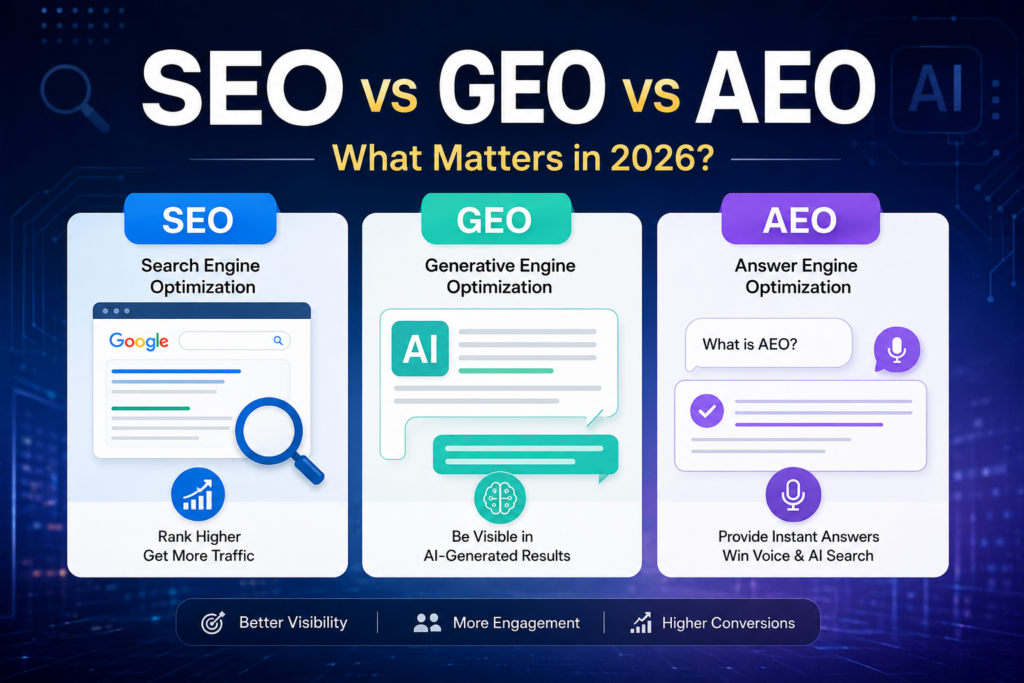
Being able to distinguish between SEO vs GEO vs AEO has become a requirement in today’s search environment.
What is SEO?
SEO stands for Search Engine Optimization, which is all about enhancing a site’s visibility on search engines such as Google and Bing. The aim of SEO is to achieve a high ranking in search engine results for specific keywords and generate organic traffic.
Traditional SEO focuses on:
- Keyword optimization
- High-quality content
- Technical website performance
- Backlink building
- Mobile responsiveness
- User experience
- Page speed optimization
SEO has played a crucial role in marketing for decades now. Even in the year 2026, SEO will remain vital since search engines continue to use site authority, relevancy, and good content to deliver their results.
However, search behavior has changed significantly due to artificial intelligence and voice-assisted search.
What is GEO?
Generative Engine Optimization (GEO) refers to the optimization of content to AI-powered search engines and generative AI platforms.
Where search engines used to only display links, they have evolved into search engines that provide answers directly through the use of information sourced from various websites. Generative AI-powered platforms condense information to give users answers immediately.
The GEO concept revolves around creating content that is clear, credible, and searchable by AI.
Key elements of GEO include:
- Creating highly informative content
- Using conversational language
- Adding structured data
- Building topical authority
- Publishing fact-based information
- Improving content clarity and context
In 2026, GEO has become increasingly important because users often receive AI-generated summaries before clicking on websites.
What is AEO?
AEO stands for Answer Engine Optimization and refers to the optimization of the content to be used as a direct answer on search engines, voice assistants, and AI answer boxes.
The main purpose of AEO is to optimize content for devices or software that requires concise and precise answers. Voice search and featured snippets fall into this category.
AEO strategies include:
- Writing question-based content
- Using FAQ sections
- Structuring content clearly
- Providing concise answers
- Optimizing for voice search
- Using schema markup
As an example, when people ask voice assistants questions, the device often provides a quick answer using content that was optimized for AEO, rather than listing multiple sites.
This means AEO becomes extremely useful in 2026 when voice search becomes even more popular.
The Key Difference Between SEO, GEO, and AEO
| Strategy | Primary Focus | Main Goal |
| SEO | Search engine rankings | Increase website traffic |
| GEO | AI-generated search results | Improve AI visibility |
| AEO | Direct answer platforms | Provide instant answers |
While SEO focuses on ranking web pages, GEO focuses on becoming part of AI-generated responses, and AEO focuses on delivering direct answers to user queries.
Why SEO Alone is Not Enough in 2026
Search engines are becoming smarter and more conversational. Users now expect instant, accurate, and personalized answers instead of scrolling through multiple websites.
Several changes are shaping the future of search:
Rise of AI Search
AI-powered search platforms summarize information directly within search results.
Growth of Voice Search
More users are relying on voice assistants to search online.
Conversational Search Queries
People are asking longer and more natural questions.
Zero-Click Searches
Users often get answers without visiting websites.
Because of these changes, businesses need a broader optimization strategy that combines SEO, GEO, and AEO.
How Businesses Should Adapt in 2026
To stay competitive in 2026, businesses should focus on creating content that works for both humans and AI systems.
Create Helpful Content
Content should answer real user questions clearly and naturally.
Focus on Topical Authority
Publishing consistent, niche-focused content helps establish expertise.
Optimize for Conversational Queries
Use natural language and question-based headings.
Add Structured Data
Schema markup helps search engines and AI systems understand website content.
Improve Technical SEO
Fast-loading and mobile-friendly websites remain essential.
Use FAQs and Direct Answers
Well-structured answers improve AEO performance.
Which Strategy Matters Most in 2026?
It is important to understand that all three are essential.
SEO serves as the backbone for visibility on the web. GEO allows companies to get featured within AI searches. AEO guarantees that the content will be available via direct answers and voice searches.
Those that implement all three strategies will dominate the digital space in 2026.
Keyword targeting is not the only thing that matters in digital marketing today. It is now about being the ultimate source of knowledge.
Conclusion
The future of the search environment will be more sophisticated, AI-powered, and consumer-oriented than ever before in 2026. Companies that solely depend on classical SEO techniques might face difficulties staying visible as AI-powered search experiences become increasingly common.
By understanding the differences between SEO, GEO, and AEO, businesses can build smarter digital marketing strategies that improve visibility across modern search platforms.
Brands that adapt early will have a better chance of reaching audiences, building authority, and staying ahead of competitors in the evolving digital world.